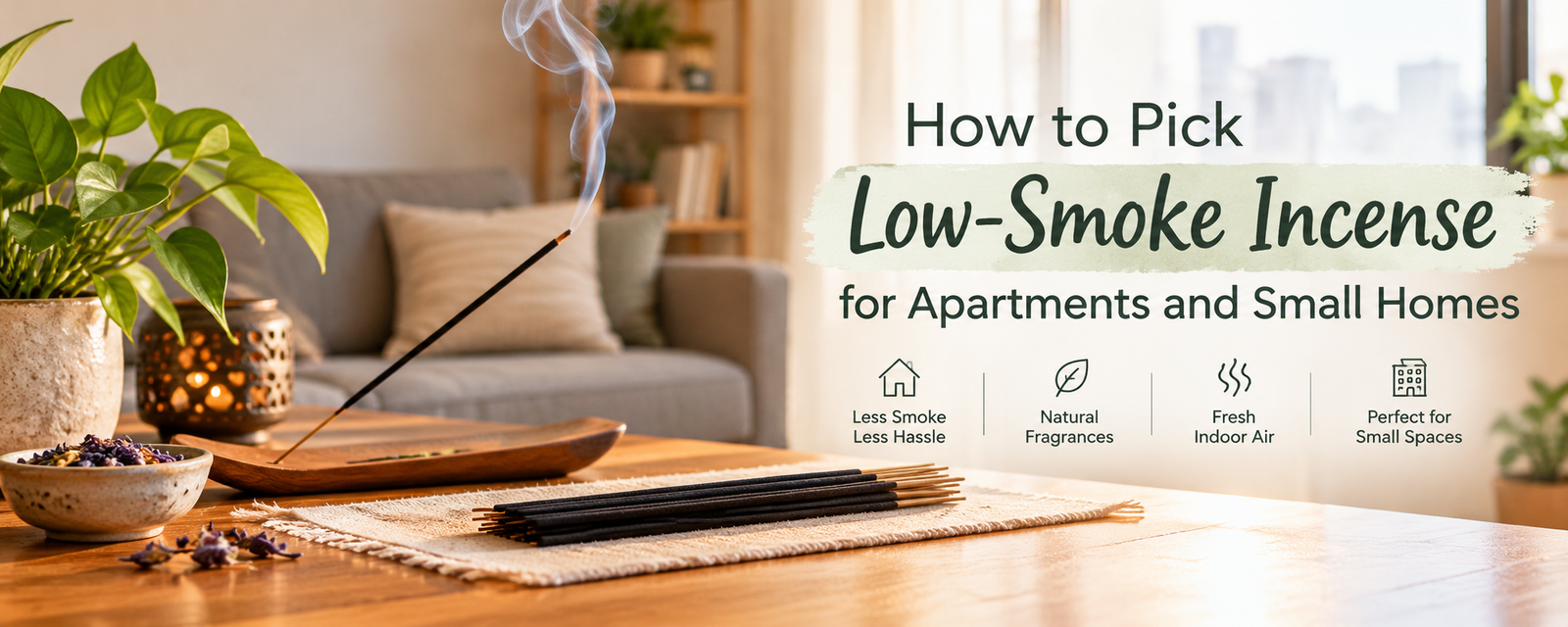
Living in a flat changes how you burn incense. Not the ritual of it — that stays the same. It's the practical bits that shift. The smoke that drifts and settles. The detector that sits about a metre from where you'd naturally put a burner. The white wall behind the shelf that's been quietly yellowing for two years.
And "low smoke" on a packet doesn't mean what most people assume it means. It's not a regulated term. Anyone can print it . So the picking has to be done on things you can actually check.
The bamboo stick is the problem
Here's the thing nobody tells you: the biggest source of smoke in a typical incense stick isn't the fragrant stuff. It's the bamboo splint running down the middle .
A cored stick is a thin bamboo spine coated in paste. The splint burns like any bit of bamboo would, producing a sharp grey smoke that contributes nothing to the scent. Strip it out and you've solved most of the problem before you've even looked at the fragrance.
That's why coreless Japanese-style sticks smoke so much less. The aromatic material forms the stick itself — no spine, no bamboo smoke . They cost more and they're more fragile in the packet. That's the trade.
Binder matters more than you'd think
The second source is whatever holds the powders together. Good incense uses makko or tabu powder — wood-based binders that burn cleanly. Cheaper sticks use starches and gums that smoke heavily and smell faintly of burning paper underneath the fragrance .
You can't always tell from the packet. But ingredient lists are a decent proxy. If a brand names its binder, that's a good sign. If it doesn't name anything at all, that tells you something too.
What "low smoke" actually promises — and what it doesn't
Worth being clear about this, because the marketing is loose.
A 2011 lab study compared six incense brands. Five conventional sticks emitted fine particulate matter at roughly 18.3 to 44.5 mg per gram burned. One product marketed as smokeless emitted about 0.4 mg . That's a genuinely enormous difference.
But it was one product among six. It doesn't mean every stick labelled low-smoke performs the same way. And less visible smoke doesn't automatically mean fewer harmful compounds — a 2017 study found particles from smoke-free, very-low-smoke and standard incense all contained PAHs and showed biological activity in cell models .
So: low-smoke is a real and useful thing. It's just not a health guarantee. The US EPA still recommends ventilating when you burn anything indoors .
What to look for on the packet
A few things worth checking before you buy.
Coreless construction. No bamboo spine. This is the single biggest factor in visible smoke .
A named binder. Makko, tabu no ki, elm bark. Something specific rather than "binding agents."
Named aromatic materials. Sandalwood, agarwood, cedar, frankincense. If the packet only says "fragrance" or "essential oils" with nothing else, it's probably a neutral blank dipped in scented oil — and dipped sticks smoke heavily and smell sharp when lit .
Smoke level stated as a category. Some Japanese brands separate "smoke level" from "fragrance intensity" and "room presence," which is genuinely useful. A stick can be low-smoke and still have a strong scent, or smoke-forward and surprisingly mild. They're different axes .
Charcoal-free. Charcoal is sometimes added as a cheap combustible. It darkens both the smoke and the smell .
Formats ranked by how much they smoke
This is probably the most practical thing in the whole article.
Heated chips, no flame — effectively no smoke at all. Needs equipment, no fixed burn time. The option if smoke is the primary concern .
Solid coreless stick — a thin, even thread of smoke. The sweet spot for most apartments .
Pressed powder trail — low smoke, sits close to the surface. Fiddly to lay, needs a level ash bed.
Cored bamboo stick — high, grey, continuous. Cheap and everywhere. Avoid for small rooms .
Cones and backflow cones — high, concentrated over a short burn. Backflow cones are designed to produce as much falling smoke as possible. The opposite of what you want .
The burner does half the work
You can buy the right stick and undo it with the wrong holder.
A lidded brass or copper censer traps heavier particles in an inner chamber while letting aroma drift out through perforations. Closed-top ceramic with controlled vents does something similar — retains heat, blocks draughts, disperses without a strong upward plume .
Precision stick holders and horizontal boxes keep embers low and direct smoke sideways, which reduces the vertical plume that trips detectors .
Thin metal tins and open plates are the ones to skip. They heat unevenly and let smoke escape unchecked .
Placement, which is free and matters enormously
Keep the burner one to two metres from any smoke detector. Not directly beneath one, not in line with its sensing vents .
Put it near an open window, but slightly inward — so gentle cross-ventilation carries the aroma out rather than blasting a plume toward a wall .
Avoid placing it directly under an air conditioning return. Avoid centring it on the desk if you'll be leaning over it.
And honestly? A balcony is better than any indoor placement if you have one.
In a small room, burn less
This sounds obvious and people ignore it constantly.
A studio or small bedroom under about twenty square metres wants half a stick, not a full one . A standard Japanese stick burns for roughly twenty-five to thirty minutes . You don't need all of it. Snuff it out and save the rest.
A small room has less air volume. Pollutants and fragrance concentrate faster. Low-smoke shouldn't be an excuse to seal the room and burn more — it should be the reason you burn less and ventilate anyway .
A few specific sticks worth knowing about
Since general advice only goes so far.
Shoyeido's low-smoke line is charcoal-free and self-combusting, with published ingredient lists — the Kyoto house has been at it since 1705 . Sandalwood-forward, 20–30 minute burn, genuinely restrained.
Koh-Do Aqua from Suwada is coreless, very low smoke, roughly 30 minutes, fresh floral with citrus. Classed as subtle intensity and gentle room presence — which is the combination that works in a flat .
Daihatsu Lavender is low-smoke, around 30 minutes per stick, and described as mild enough for smaller rooms .
Asayu Japan makes low-smoke sticks in Awaji, around 25 minutes, no chemical fragrances .
None of these are cheap. That's the honest cost of the low-smoke trade.
The one thing that doesn't change
Ventilation.
Every source I read says the same thing: burning anything indoors produces particles, and low-smoke reduces them rather than eliminating them. Open a window. Not a gale — just gentle air exchange. Burn for a shorter time. Don't treat a low-smoke label as permission to fill a sealed room with scent.
And if you have asthma, respiratory sensitivity, a newborn, or birds in the house — birds are particularly vulnerable to combustion smoke — then the honest answer is that burning incense at all may not be the right call. A diffuser does the scent without the combustion.
The low-smoke option is a better version of a thing that still involves fire. Worth knowing the difference.