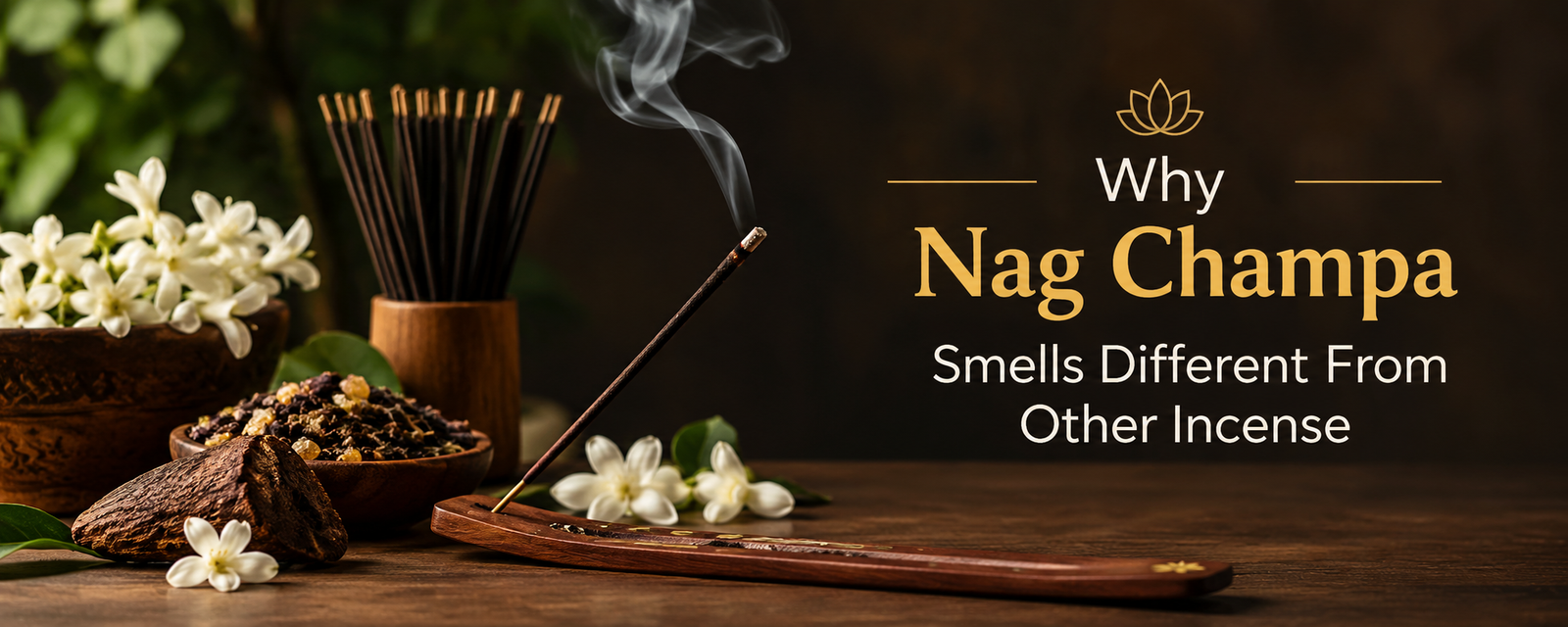
You can smell it from the next room. And you know exactly what it is before anyone tells you. That's the thing about Nag Champa. It doesn't smell like "incense." It smells like itself. Sandalwood, sure. Something floral, something sweet, something almost creamy underneath. But if you've burned it before, you recognise it instantly, and no other stick quite replicates it. There's a reason for that. It's not marketing. It's chemistry, and it comes down to one ingredient most people have never heard of.
Nag Champa isn't a flower
Most people assume it is. The name sounds like one. Champa is a flower, sure — the frangipani, plumeria, the white one you see everywhere in temple courtyards and roadside gardens across India. It's a familiar smell if you grew up here. Warm evenings, pooja at home, the little bowl of champa petals by the door. But Nag Champa incense isn't just champa flowers ground into a stick. It's a blend. A masala blend, made from a base of sandalwood powder, mixed with champa fragrance, and — this is the part that matters — halmaddi. If you've never heard of halmaddi, you're not alone. Most people haven't. They've been burning Nag Champa for years without knowing what makes it smell the way it does. But it's the entire reason the stick is recognisable.
What halmaddi actually is
Halmaddi is a resin. It comes from the Ailanthus triphysa tree, tapped from the trunk the way you'd tap rubber. In India it's mostly sourced from the forests around the Maharashtra–Gujarat belt and parts of central India. Small-scale collection, mostly. It's not a factory ingredient. Fresh halmaddi is sticky. Greyish. Smells faintly sweet, almost like honey mixed with something resinous. When it's mixed into the incense paste, it does three things at once. It carries fragrance. Holds onto the scent and releases it slowly as the stick burns, rather than dumping the whole lot in the first minute. It softens the burn. Nag Champa doesn't scorch the way a dry charcoal-based stick does. It smoulders gently, which is why the smoke feels less harsh on the throat and eyes. And it leaves that sweet, resinous, slightly vanilla-like note underneath everything else. That note is the signature. That's what your brain recognises as "Nag Champa" before you've consciously identified the smell. There's no synthetic substitute that does all three. You can fake the sweetness. You can't fake the way halmaddi changes how the stick burns.
Most incense is built completely differently
Here's the contrast, and it explains a lot. The majority of incense sold today — the cheap, mass-produced kind — is a bamboo stick dipped in a charcoal paste, then dipped again in fragrance oil. The oil is synthetic. The charcoal is the fuel. The bamboo is the skeleton. That's why it smells sharp when you light it. The fragrance hits you all at once, then fades fast, and there's a faint burnt-wood smell underneath that never quite goes away. It's why cheap incense always smells better in the packet than it does in the room. Nag Champa doesn't work like that. It's a masala incense — the fragrance is mixed into the paste itself, not sprayed on afterwards. The paste is rolled by hand around the stick. It's slower to make, harder to scale, and considerably more expensive per stick. And it smells like a blend, not a single note. You get the sandalwood at the base, the champa floating above it, and the halmaddi binding it all together with that sweet resinous undertone. Three layers, not one. That layered quality is why Nag Champa doesn't get boring the way a single-note fragrance does.
Why some Nag Champa smells wrong
Not all Nag Champa is equal, and this is where people get burned. Real halmaddi is expensive and its supply is inconsistent. Harvesting depends on the season, on forest access, on collectors willing to do the work. So plenty of manufacturers substitute it — synthetic resins, cheap fragrance oils, sometimes just extra charcoal with a champa scent added. It looks the same in the packet. It costs a fraction to make. Light one of those and you'll notice the difference immediately. The sweetness is harsh instead of soft. The smoke is heavier. The scent fades within ten minutes and leaves nothing behind. It smells like a copy of Nag Champa rather than the thing itself. The other giveaway is texture. Real halmaddi keeps the stick slightly moist. Press a genuine Nag Champa stick gently and it gives a little. Cheap substitutes are dry and brittle. If the stick snaps the moment you touch it, that tells you something before you've even lit it. Colour is a clue too, though not a reliable one. Genuine masala sticks tend to be uneven, slightly textured, sometimes a little darker in patches. Mass-produced ones are uniform and smooth because they've been machine-dipped. Perfect symmetry in incense is usually a sign of a factory, not a craft.
What we do with Karma Sugandhit Nag Champa Fragrance Sticks
This is where I'll stop pretending to be neutral. We make Karma Sugandhit Nag Champa Fragrance Sticks in the traditional masala style. Hand-rolled. Sandalwood base. Champa blend on top. No bamboo core that burns along with the fragrance, no charcoal filler, no synthetic fragrance sprayed over a cheap base. The result is what Nag Champa is supposed to be. Soft smoke. A sweetness that sits in the room rather than hitting you in the face. And that unmistakable after-smell that lingers for an hour or two once the stick is done — the thing people actually remember when they think of Nag Champa. It's not the cheapest Nag Champa you'll find. We're not going to pretend otherwise. But it's the real blend rather than an imitation, and once you've burned both, the difference is not subtle. Your nose figures it out before your brain does.
How to actually smell the difference
A few things worth knowing before you judge any Nag Champa. Don't judge it in the first thirty seconds. The opening note is always the sharpest. Give it two or three minutes to settle. The halmaddi sweetness comes through after the initial burn, not during it. Burn it in a small room. Nag Champa is dense. In a large open space it disappears. In a bedroom or a small living room, you get the full picture.
And notice what the room smells like after the stick is out. That's the real test. Cheap incense leaves nothing. Good Nag Champa leaves a faint sweet resinous trace that hangs around for a while, and that's what people are actually paying for. If you want to compare properly, burn one stick in the morning and another in the evening on the same day, in the same room. Your nose will tell you which one is real before you've finished the second stick.
Frequently Asked Questions
What does Nag Champa actually smell like?
Sweet, resinous, and slightly creamy, with sandalwood underneath and a floral champa note on top. It's warmer and softer than most incense — less sharp, less smoky. Most people describe it as earthy-sweet with a faint vanilla-like undertone that comes from the halmaddi resin.
What is halmaddi and why does it matter?
Halmaddi is a natural resin tapped from the Ailanthus triphysa tree, mostly found in central India and the Maharashtra–Gujarat belt. It's what gives Nag Champa its signature sweetness, helps the fragrance release slowly as the stick burns, and keeps the smoke soft rather than harsh. Without halmaddi, it isn't really Nag Champa.
Is Nag Champa the same as champa flower?
No. Champa is a flower — frangipani or plumeria. Nag Champa is an incense blend made with sandalwood, champa fragrance, and halmaddi resin. The name refers to the blend, not the flower itself.
Why does cheap Nag Champa smell different from the real thing?
Most cheap versions skip halmaddi and use synthetic resins or fragrance oils instead. The sweetness turns harsh, the smoke gets heavier, and the scent fades within minutes instead of lingering. Real halmaddi is expensive and supply is inconsistent, so substitutions are common.
How can I tell if Nag Champa is genuine?
Three things. Texture — real Nag Champa is slightly moist and gives a little when pressed, while cheap versions are dry and brittle. Smoke — genuine sticks burn soft with thin white smoke. After-smell — real Nag Champa leaves a sweet resinous trace in the room for an hour or two after burning. Cheap ones leave nothing.
Is Nag Champa incense safe to burn indoors?
Yes, in a ventilated room. All incense produces some smoke, so crack a window open a couple of inches. If you're sensitive to smoke, burn it briefly before you sit down rather than throughout, or use a low-smoke masala variety.
Why does Nag Champa smell stronger in a small room?
The fragrance is dense and the halmaddi releases it slowly. In a large open space it disperses and disappears. In a bedroom or small living room, the scent builds properly and you get the full layered effect — sandalwood base, champa top, halmaddi underneath.
How long does Nag Champa incense burn?
A standard stick burns for roughly 30 to 45 minutes, depending on thickness and airflow. Masala-style Nag Champa tends to burn slightly slower than charcoal-dipped incense because the paste is denser.
What does Nag Champa Agarbatti smell like?
Nag Champa agarbatti (incense sticks) smells sweet, earthy, floral, and warm-woody all at once.
Core Scent Profile
Opening (Top Notes): Softly floral and slightly sweet with hints of magnolia, frangipani (champa), or jasmine.
Heart (Middle Notes): Creamy, rich, and smooth sandalwood combined with a warm, slightly spiced or honeyed edge.
Base (Lingering Notes): Deep, resinous, and grounded earthiness—often anchored by traditional ingredients like halmaddi resin.
Can we keep Nag Champa at home?
Yes, you can easily keep Nag Champa at home as a living plant in a pot or garden, or burn its traditional incense and oils for a calming fragrance.